Sleep
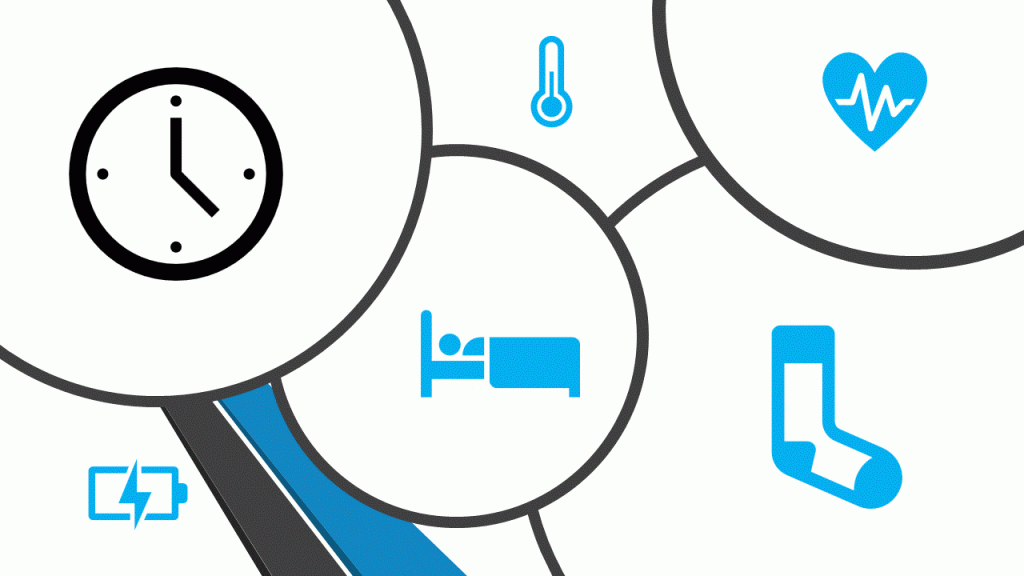
A very easy and effective intervention would be sleep. It is well known that sleep management building up to competition is key. There are many strategies that competitors can use such as sleep extension which consists of increasing sleep at night as well as napping during the day (Poussel et al., 2015). Increased sleep time in a recent study found that more sleep before the race completed the race more quickly (p<0.0257). It has been advised that athletes should aim for a minimum of eight hours sleep per night (Martin et al., 2018).
Cold water emersion
Cold water emersion has been found to be a cheap and effective recovery strategy. This method has been shown to reduce blood flow and reduce inflammatory movement. It has also been suggested that cold water emersion reduced pain perception as it impacts the nerves (Eston, 1999). However, research has recommended that this method should only be used during demanding training schedules because It has been suggested that if it is regularly used, it diminishes key protein in the skeletal muscle (Leeder et al., 2012).
Massage foam roll
Massage foam roll is a widely used method for recovery. It has been identified to prevent delayed onset muscle soreness (Pearcey et al., 2015). This method is basically using an athlete’s own body weight in order to apply pressure to specific parts of the body. Moreover, the results of this method seem inconclusive as there is limited proof that it helps muscle function(ref). However, research has shown that it provides benefits to an athlete’s flexibility. A study by Healey et al., (2015) examined delayed onset muscle soreness after exercise and found that flexibility was increased as well as a decrease in muscle soreness. It stated that the pressure in the areas may have stimulated muscle activity through the CNS (central nervous system). Therefore, it would be appropriate to carry out this method after exercise to reduce muscle soreness and improve flexibility (Junker, 2015).
Compression garments
Compression garments apply pressure onto the body surface to support the bodies tissue. The mechanisms behind are not fully established and research has demonstrated that the results could be either psychologically or physiologically. Some studies have found that compression garments reduced muscle damage whereas other research states that participants showed that it effected their perceived muscle soreness (MacRae et al., 2011). Despite the lack of research on how it occurs, there is valid research on its benefits. It has been recommended that they should be worn immediately after exercise and kept on for 24 hours or more (Davies et al., 2009).
References:
MacRae, B. A., Cotter, J. D., & Laing, R. M. (2011). Compression garments and exercise. Sports medicine, 41(10), 815-843.
Poussel, M., Laroppe, J., Hurdiel, R., Girard, J., Poletti, L., & Thil, C. et al. (2015). Sleep Management Strategy and Performance in an Extreme Mountain Ultra-marathon. Research In Sports Medicine, 23(3), 330-336.
Davies, V., Thompson, K. G., & Cooper, S. M. (2009). The effects of compression garments on recovery. The Journal of Strength & Conditioning Research, 23(6), 1786-1794.
Eston, R., & Peters, D. (1999). Effects of cold water immersion on the symptoms of exercise-induced muscle damage. Journal of sports sciences, 17(3), 231-238.
Leeder, J., Gissane, C., van Someren, K., Gregson, W., & Howatson, G. (2012). Cold water immersion and recovery from strenuous exercise: a meta-analysis. Br J Sports Med, 46(4), 233-240.
Junker, D. H., & Stöggl, T. L. (2015). The foam roll as a tool to improve hamstring flexibility. The Journal of Strength & Conditioning Research, 29(12), 3480-3485.
Martin, T., Arnal, P., Hoffman, M., & Millet, G. (2018). Sleep habits and strategies of ultramarathon runners. PLOS ONE, 13(5), e0194705.
Pearcey, G. E., Bradbury-Squires, D. J., Kawamoto, J. E., Drinkwater, E. J., Behm, D. G., & Button, D. C. (2015). Foam rolling for delayed-onset muscle soreness and recovery of dynamic performance measures. Journal of athletic training, 50(1), 5-13.
Healey, K. C., Hatfield, D. L., Blanpied, P., Dorfman, L. R., & Riebe, D. (2014). The effects of myofascial release with foam rolling on performance. The Journal of Strength & Conditioning Research, 28(1), 61-68.

