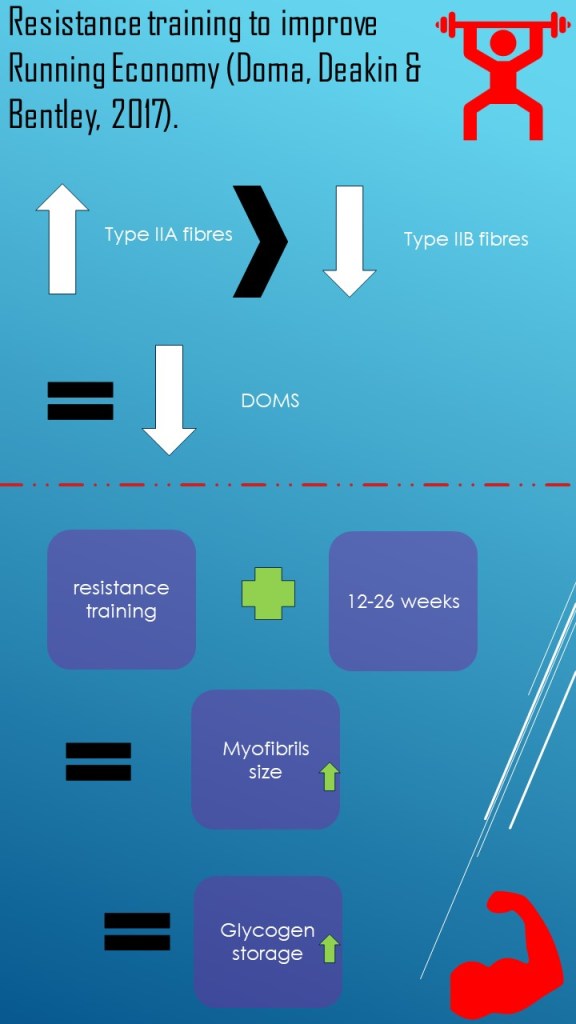
Resistance training is well known to help improve performance for an ultra-marathon runner. This is due to an increase in Type IIA fibres and a decrease in type IIB fibres which allows muscles to be more powerful which improves running economy (Doma, Deakin & Bentley, 2017). This type of action involves stretching the sarcomere which then strains the myofilaments causing delay onset muscles soreness (DOMS) (Aaron Bubbico & Len Kravitz, 2010). It can therefore be proposed that athletes use the repeated bout effect approach to resistance training as this is well known to reduces DOMS by stimulating the muscles repetitively. Also, for beginners wanting to participate in a race it would be appropriate for them to carry out resistance training as research has shown that it increases muscle glycogen storage due to the improvements of myofibrils size between 12-26 weeks and that it is beneficial for neuromuscular system up to the first eight weeks (Bird, Tarpenning & Marino, 2005). It is important to note that a training partner is necessary during this type of training to help reduce risk of injury.
References:
Doma, K., Deakin, G., & Bentley, D. (2017). Implications of Impaired Endurance Performance following Single Bouts of Resistance Training: An Alternate Concurrent Training Perspective. Sports Medicine, 47(11), 2187-2200.
Bubbico, A., & Kravitz, L. (2010). Eccentric exercise: A comprehensive review of a distinctive training method. IDEA Fitness Journal, 7(9), 50-59.
Bird, S., Tarpenning, K., & Marino, F. (2005). Designing Resistance Training Programmes to Enhance Muscular Fitness. Sports Medicine, 35(10), 841-851.

